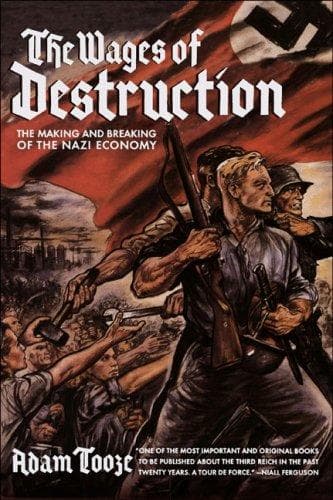
The Wages of Destruction: The Making and Breaking of the Nazi Economy
Adam Tooze
Read September 17, 2022
View on Goodreads →Do you like dense economic history? No? What about if we add NAZIs?? Still no? What a weirdo.
I can't believe I waited so long to read this one. It is much praised and rightly so, both as a standout study of economic history but also one that highlighted gaps and misunderstandings in mainstream history of the period.
I learned so much, in typical Tooze style both from standout one liners (both East and West Germany paid more in reparations than the Weimar republic ever did), and from complex thoughts that take pages to articulate. I thoroughly recommend his newsletter "Chartbook" for more each week, the 'One's and Tooze' podcast for a lighter version as well.
One of the larger points is how Hitler's vision and implementation of his plans can be framed as a rational response to the economic rise of America. A country often missed from other analyses - Hitler wanted 'living space' for the German people to build a market large enough to compete with the American colossus, and to a lesser extent the British Empire, whose living standards so outshone those of Germany. He knew time was not on his side, and he knew how those Empires were taken - violently. He saw one last chance for the German people to join the top table, or face obliteration because of his insane, driving-force conviction of a global Jewish conspiracy.
His belief in this, so openly stated and acted upon by all the top NAZIs for decades, is also often overlooked. I did not know about Hitler's so called 'Second Book', a collection of speeches and thoughts expanding on the American question. This is happening today with Putin and Ukraine. Putin too has written and spoken his thoughts openly, then acted upon them. Both are wrong, both have wrought terrible wars and destruction.
The belief also rationalises (to an extent) the craziest decisions, the decision to invade his erstwhile ally the Soviet Union while stretched in the West (a "adolescent, belated and perverse outgrowth of an as yet unknown obsolete European colonial settlement and expansion model"), the decision to declare war on the US (he considered it war already, economically it was) and the decision to both start the Holocaust (there were many 'reasons'!) and then to continue it when faced with acute manpower issues (political overruling the practical). They are all framed as part of the same global Jewish conspiracy.
Given the economic situation it is no small miracle (and a huge tragedy) that the NAZI's were able to grab power, kept it, start winning and then kept going despite the enormous economic odds. The book really illuminates the early years - with the German leadership (Strassman in particular) trying to play the US off against the European rivals - it so nearly worked. There was indeed room for all at the top, and violence was not the only route. There were many times in the early NAZI years economic impacts could have toppled the regime. Steven Pinker in the excellent "The Better Angles of our Nature" notes just how 'unlucky' the world was to end up with Hitler, how so much of that conflict seems to rest with him in particular. This only adds to the case. The going can be a little slow in the early chapters as the war is many years away, but it's all very relevant. The pace picks up as the build up and war come, Tooze does a great job in staying focused on the economic side, it would be so easy to stray into the war itself - you get enough but for a full breakdown you should look elsewhere, Anthony Beevor's "The second World War" is excellent https://www.goodreads.com/book/show/13528287-the-second-world-war?ref=nav_sb_ss_3_20.
The myths of German armed forces superiority are also rendered clearly. They did have some outstanding hardware (though often from later in the war) yet the Blitzkrieg tactics and wider strategy were used almost by accident - and executed with the assistance of drug fuelled (though excellent) troops. Much more detail on this in the great "Blitzed" by Norman Ohler https://www.goodreads.com/book/show/29429893-blitzed?ac=1&from_search=true&qid=tYicHSe8M6&rank=2
While the Americans were going nuclear most of the German army walked into Russia with horses dragging their gear not unlike Napoleon's Grande Army. By the time they modernised it was thankfully far too late, the crushing weight of the allied powers destroying their ability to wage war.
Albert Speer receives a well deserved and evidence based character assassination. He seems to have got away with what should have been a simple and clear death penalty. His image is indeed cleaner than it should be - driven by a late repudiation of the whole NAZI party and best selling, self-serving memoir. There is simply immense blood on his hands. His economic 'miracles' as also brilliantly refuted.
First rate book, essential for those deeply interested in the period.