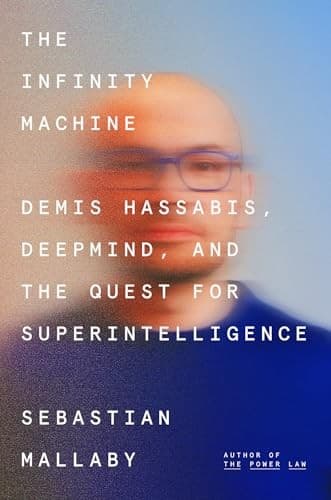
The Infinity Machine: Demis Hassabis, DeepMind, and the Quest for Superintelligence
Sebastian Mallaby
Read August 19, 2026
View on Goodreads →This is an outstanding story, biography, and history of the last twenty years or so in AI by the writer and journalist Sebastian Mallaby. It will make my (and many others') book of the year lists without doubt.
The biography helps place the news that Demis has moved to a new, seemingly freer yet less controlling role into context. He is framed as a scientist concerned with the big questions of the universe, not the mundanity of racing to build and manage a billion-user product. I feel it is a fair portrait.
"I am first and foremost a scientist. We are understanding what you may call god... at 2am reality is screaming at me, just trying to tell me something, there is a deep deep mystery here... we don't really know what time is or what gravity is, I would like to understand"
It is also the story of an incredibly talented and determined person, one who has been crystal clear about what he wants to do - create artificial general intelligence - for decades. He is a Nobel-winning scientist, a visionary thinker, and his words and timelines should carry their due weight: "we are in the foothills of the singularity", meaning that AGI is "a few years away".
Big Picture
To its credit the book does not shy away from the big ideas, the big questions. Indeed we start with quotes from John von Neumann about nuclear weapons in the preface. Fitting.
Demis is not alone in signalling the age of AGI or indeed the Singularity - the moment machine intelligence surpasses combined human intelligence and transforms the world beyond what we can describe clearly at present. In some narrow areas machine intelligence already surpasses us of course, and increasingly it is matching us. Recursive Self Improvement (RSI) - having machine intelligence design and build the next generation of AI - is a clearly stated short-term goal of both Anthropic and OpenAI, while Sergey Brin has reportedly made it a priority back at Google. Both of the frontier labs have noted where their AIs have already helped build the next generation. It is one reason, along with the historic capital expenditure in the great build out, that so many timelines from those close to the industry have shortened. Mine too, from greater than 50% chance of undeniable AGI by 2032 to 2029. Mine are long compared to a lot of people with far more knowledge.
We already live in a time of high weirdness and it will never be this sedate again. We live in a time of high danger too, one that many people easily dismiss as sci-fi. The recent autonomous swarm attack on Hugging Face is a wake-up call. We were lucky it was fairly benign and that we found it. We can't expect to be so lucky again. The early focus of DeepMind on safety was reassuring to read; all three cofounders - Mustafa Suleyman, Shane Legg and Demis - cared enough to make it a huge part of the deal with Google. But the loss of at least two of these three from key positions is worrying. Demis was recently courting the Trump administration and others on an American-led regulatory body for instance, but do the other power brokers at Google care as much?
While Demis claims to do it for the science, he states that OpenAI's Sam Altman does it for power. Demis never intended a capitalistic race between labs, rather a quiet scientific endeavour. This plan was at best idealistic - has he not met other people? The race is currently very much on and is clearly creating a dangerous situation, exactly what he tried to avoid. When pushed on personal power he says "no, I just had to accumulate power because of large teams... until we figure AGI out I need some money, some power". Hmm.
The Journey
The introduction is a bit of a glow-up, describing his big goals and big vision from early on. A chess prodigy from a modest background, he had his epiphany at a tournament in Liechtenstein aged 12 - "all these smart people wasting their minds on a game". He loved understanding the game (and competing), not the game alone. He knew he needed a mission, a purpose, so why not understanding itself?
This would drive the major choices in his life. Deciding between studying physics or neuroscience, he chose the latter as he deemed it more important, more fundamental. The thought was that while mathematical language and deduction may be right for physics, they lack the ability to describe the real world, biology and human-like intelligence, as it is inductive, messy, based on huge data and pattern recognition. Information is labelled as the fundamental block of the universe. To understand this world we would need a new type of computer, but one based on what we have, stepping up not reducing down.
For his neuroscience PhD he researched the link between memories and creativity, proposing that some patients with memory issues would be unable to imagine things, and it was bang on - the work was named one of Science's breakthroughs of the year.
We should add that one of the reasons given for not choosing physics is that he was worried by the failures of Einstein and Feynman to get a unified theory. The only way he thought he could do it was with machine assistance. This worry, I think, shows two things: that he wanted to push fundamental science forwards, and that he wanted the recognition, the kudos, the Nobel Prize. He's already done both - and I think it's a fun bet that he will win another Nobel, joining only five others with two. I think his work at Isomorphic Labs can change medicine forever.
"He has incredible determination. His dad told him it doesn't matter if you win or lose, it's that you tried your best, and he understood that as give 100% all the time. He has no 99% mode in him - your best is to die, not literally, but burnt out, falling over the line. The limit." - Shane Legg, DeepMind cofounder
There is a great contrast at the end of the introduction from Geoff Hinton, another Nobel-winning luminary in AI (neural networks specifically), with his warning that people will be tempted to abuse AGI, but especially to build it once they know they can. It mirrors Oppenheimer's line that when you see something that is technically sweet, you go ahead and do it. Could we stop a step away?
His early career is super interesting. Obsessed with computers as well as chess as a boy, he started writing games. As a teenager he interned at a wild game startup (Bullfrog, run by the maverick Peter Molyneux). He was extremely successful, co-writing the awesome Theme Park games (I loved these) that featured very early AIs. The Bullfrog owner offered 17-year-old Demis £500k, a huge sum for a teenager. He wrote out the cheque and handed it to him to tempt him to stay and work on the next game, but he wanted to go to uni like his scientific heroes. He loved a movie telling the story of Watson & Crick at Cambridge, so that's where he went.
After excelling at uni he would do something strange for his cohort - start his own company, a game company. Here too he had early success, but then his vast ambition took him and new collaborator David Silver down the road to failure. A hugely ambitious new game would fail to materialise and the company would fold. It gave Demis his first tastes of real leadership, fundraising, and big business. All crucial later.
It was only now that he went to do his PhD. Afterwards, once again, he would turn down incredible money in the video game world as he planned to move on to his life's work, solving AI. The academic world did not seem the right fit for this; he knew he would need a lot of compute, a lot of funding, so...
DeepMind
After struggling to find like-minded collaborators during his PhD, Demis engineered some luck and introduced himself to kiwi researcher Shane Legg, a man deeper into the existing AI world. They clicked, and needed one more piece to found DeepMind - Mustafa Suleyman, now Microsoft AI CEO. He was a childhood friend of Demis's brother and has an incredible personal story: from further down the social ladder than Demis, he is presented as fearless, principled, and driven. He earned his way to Oxford only to drop out. I've read his book and never knew either this background or the manner of his DeepMind departure, both covered well here.
DeepMind was very much Demis's baby; the other cofounders did not have equal ownership shares. Demis was here in founder mode. Using his "Jedi mind tricks" and his amazing ability to storytell, he would convince and inspire researchers to join and to excel. His early experience working at Bullfrog and at his own game startup shines through - he gave people more freedom to tinker and play. Mallaby points out that there is a fine line between inspiration and control, dark and light.
Needing finance beyond his own limited funds and what was on offer in the UK, the boys headed to America.
"Demis is a true entrepreneur, he would do it for free. He will never quit. Big ambition." - Peter Thiel
Founders Fund would be the primary early backers, seeing the contrarian bet - a moonshot idea led by a brilliant founder. This was long before the AI we have today, before transformers and LLMs; it really was an expensive long shot at the time.
The pitch was a blend of neuroscience and computing, putting together neural nets and reinforcement learning, two previously polarised AI camps. DeepMind's roadmap was prescient. One aim was to ground intelligence in a world model, as without this a system could not be truly intelligent like humans. Later aspects of the neuroscience were dropped, and while world models are not yet in place, LLMs have taken off. Their projections are on track. The ~2030 AGI forecast now looks almost conservative, but it was radical 15 years ago. Shane Legg predicted it for 2028 even before DeepMind.
DeepMind was up and running, the best researchers were attracted and they worked on fundamental research and big flashy breakthroughs - often in games.
Move 37 & Protein Folding
Go is a deceptively complex board game that is hugely popular in the Far East. Unlike chess, computers were not able to defeat the best humans. Demis set his old friend and reinforcement learning specialist David Silver and team on the task. They made great progress and Demis set up a match against Lee Sedol, one of the highest-ranking players, in a televised and highly publicised event with a $1 million prize.
DeepMind's program AlphaGo would win the series 4-1. But it is move 37 of game 2 that is famous. The move was considered a mistake, something no good player would do. Only late in the game did its genius become apparent. It was creative, something outside of established play, a new way to play. 18 months later a new version, AlphaGo Zero, would beat this version 100-0. It was special as it used no human training data; it learned from playing itself and it blew past not only the best humans but the best AIs trained on human play.
High on the success, Demis pivoted many from the team onto a project he had been thinking over since his uni days, a real scientific problem: the structure of proteins.
The shape of the problem was good for AI - huge labelled datasets, clear input and output, and a blind-marked benchmark, CASP, that ran every few years. In 2018 they won the competition, a little better than anyone else. In 2020 they completely dominated, causing the surprised organisers to say protein folding for single-chain structures was essentially solved. A true breakthrough, this won Demis and project lead John Jumper the Nobel Prize in Chemistry in 2024. Demis, the son of a Greek-Cypriot father and Chinese-Singaporean mother, was knighted the same year, one of the UK's highest honours.
Google & Business
Much of the funding for this research was only possible because DeepMind was sold to Google in 2014. Outgrowing Founders Fund despite some late Elon Musk attempts, and having skilfully avoided Mark Zuckerberg, Demis decided to go with Google as he thought it was the best path to realising his overall goal. The cofounders adroitly negotiated key safety frameworks and maintained a lot of independence.
The early years brought the successes above, but tensions and reality would bite later on.
Google researchers would invent the transformer, the key technological step that powers LLMs. This is brilliantly explained by the author. They would not press home their lead here and missed the early revolution. There was more to LLMs than language; scaling them brought reasoning and understanding about the world. Demis is humble enough to know he missed this.
Google also had a version of ChatGPT a year before OpenAI, but buried it due to worries around hallucinations and the core search business. A massive miss given how things went, but it is understandable - I thought the same writing a blog post on how their search business was threatened by Perplexity and the best LLMs. Google is doing better than ever even with second-rate LLMs, so far.
Demis and Google were blindsided by Sam Altman and his rush to productise ChatGPT and his global publicity tour. Demis was furious at the starting gun of a race being fired; he felt that he too simply had to race, also publicly. This is the cold logic of technological determinism and capitalism. Google powered back in product space, by no means Demis's home field, but ever the competitor he was trying hard as part of Google. I feel you can still see this in his public comments today: he performs for the business, and is excited for the deeper science. Bard would launch already behind OpenAI. In some areas they would catch up, in narrow areas like video even surpass. But the vibes have never really shifted. Now, post Demis leaving as CEO, it is unclear if they will return to the AI frontier.
This relative success was despite Google having competing internal AI teams; Google Brain was run as a separate function outside of DeepMind for years, hampering overall progress. They would fail with Gaia, an attempt at world models, before language models powered ahead.
I was struck by the role of Sundar Pichai, Google CEO. Demis coveted independence and worked on a DeepMind spin-out, even convincing Larry & Sergey, but he was outmanoeuvred by the softly spoken and non-confrontational Sundar. Highlighting his vision with AI at the core of Google, Sundar would tease and delay and block spin-out ideas. Now we see a DeepMind VP (not CEO) reporting to Sundar, with Demis moved upstairs to Chair of DeepMind and Chief Scientist at Google. I think they wanted to keep him as long as possible and ideally never lose him, but they also need Gemini to succeed as a core part of the Google offer. Unlike, say, Waymo. Smart moves from Sundar; he's not CEO of Google for no reason.
Big Plans
There are lots of great philosophical quotes to go with those from the famed scientists and mathematicians. You will hear from the likes of Spinoza, Einstein, Kant, Gödel and Nagel, and read about their (and others') big ideas - brains in vats, simulation theory, the universe as God. Fun stuff. Taking a step back you can see Demis aiming to place himself in this tradition, the next step, and maybe one of the last we take as a species without machine intelligence.
It is in this domain he sees his future. He would like to solve intelligence, and from that disease, energy, physics, everything.
"Humanism, spiritualism, and science all go together... like Spinoza, Einstein, Da Vinci, it's art and science... it's fluid, everything is a river. Philosophy is a way of life. Self knowledge, knowledge, from sand and copper we get semiconductors... God's design... the flow is going towards finding out, understanding, I'm part of that and it's exhilarating" - Sir Demis
When asked how he spends his cash: not on fancy cars, houses or yachts, his only indulgences being some first edition books and Liverpool FC tickets (up the Reds!).
He wants to build a massive particle collider in space to help answer the big questions in physics ("what I cannot create, I do not understand" - Feynman). He wants to know if the universe is quantum or not, how we can describe the universe at the base level. He is a classical computer champion, positing that we don't need quantum explanations and that Turing machines can explain it all in 1s and 0s if powerful enough. He sees quantum mechanics as an inefficient way to run the universe and would like to cut out the weird stuff.
These ideas and goals are the great promise of artificial intelligence. But we will end on the threat.
"AGI is coming, we are not where we hoped we would be but it's coming" - David Silver
There are catastrophic and existential threats posed by AI. My p(doom) - the chance of things going this wrong in the next decade or so - has recently moved up to ~15%. I'm not alone in saying we might kill everyone, end civilisation, or lose human control over it very soon. I feel better knowing how seriously Demis takes the issue; I worry the conditions now in play raise the risk. I commend OpenAI's recently announced pause at the frontier to allow alignment work to catch up. We need a lot more work here at technical, business, and political levels to keep us on a happy path.