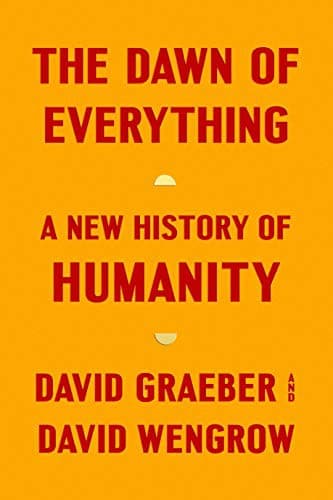
The Dawn of Everything: A New History of Humanity
David Graeber
Read August 25, 2023
View on Goodreads →4.5* This is a brilliant, provocative, and somewhat messy book – much
like the history of our species in total. The scope here is vast, the terrain uneven and complicated yet we emerge with a far greater understanding of what we both know, and more clearly what we don’t regarding the journey of humanity.
The historical analysis is first rate, some of the best I’ve ever read. However, some of the reasoning, together with some of the
authors ideas as to how, what and why things may have gone the way they did is grasping. I think some of it stems from what I see as a
negative socio-political outlook of present times.
One of the most exciting things with reading (with learning more generally) for me is overturning ideas I already had in my mind, how something fixed I thought I knew is either based on shaky ground or is plain wrong. A huge compliment to this work is that it did this for me repeatedly. On both small and large scales.
The book is excellent on breaking the linear idea of development and highlighting where this originated. I have broadly absorbed this
narrative despite (because?) of high-level university courses and famous books. It does not fit the evidence at small to medium time
scales – the long view of history? That remains open in my view.
In the same vein they assess ‘technology’ as the core signifier of development & civilisation through epochs. We live in such a
technology fixated age, and we may project this backwards.
There is plenty of evidence for technological development being invented for use in rituals, for play not for societal change. Farming
of several crops itself looks geared to religious offerings in Egypt, not food for people (leading to debt inequality). Same for pottery
(figurines), mining (pigments) steam engines (cool door openings), wheels (for toys in the Americas, not carts).
Rather than looking into what metals people used, or what enormous monuments they left behind could we ask how happy the people were? How free to live life as they saw fit? How peaceful it was? Yes, we should. And for sure in places people were better off outside of
crushing empires of coercion living in smaller tribes. Pinker has lots of data saying it would not have been so safe everywhere however! I
remain unconvinced either way on the violence question, but the day to day I take the good point made in this work.
We are reminded that clearly sedentary ‘civilisations’ don’t tell the whole story. The Mongols, who left little in terms of grand buildings, fought Japanese, Javanese, and Christian knights at the same time who
never even knew the others existed. They too were organised, powerful, technologically advanced. Some Native Americans chose to leave civilisation (settled cities/towns) and live freer in harmony with their surroundings.
The authors brilliantly show how modes of production are not the silver bullet either – the key transformational change highlighted by
so many other writers. They provide instructive examples from a huge range of societies. Farming was clearly a choice, not a default or a
trap, and its use waxed and waned across time and geography – there was no single agricultural revolution, the shift of farming to core focus took millennia. Language groups, and modern studies of the remaining hunter gatherers receive the same excellent treatment among other famous theories.
One of the main themes of Yuval Harari’s Sapiens is that humans are both master storytellers (and story followers), and he succeeded in writing an amazing story for us to follow. However, maybe it was too clear, too well constructed, here the narrative follows more closely what seems to have actually happened in the deep past, it’s stop
start, here and there, not quite neat and coherent but always insightful.
The authors specifically call out two of my favourite writers/books for criticism – Pinker’s The Better Angels of our Nature and the
above-mentioned Sapiens. The criticisms are fairly minor, stating they make large assumptions that the evidence does not back up, even when they state this themselves. Fair enough, though hilariously they do
the exact same thing here, repeatedly assuming the current world is falling to pieces around us when the evidence points the other way on almost every metric (environmental being the only real, but very important outlier). I feel their political persuasions shine through
here, rather than the evidence. Are we ‘stuck’ unable to imagine other social worlds? I’m not convinced. This is a small part of the book,
more concerned with how to change or what to do, it is weaker than the main body, where they analyse, and teardown established history
brilliantly.
A huge portion of the book focuses on Freedom, it is most interesting. It centres mostly on some Native American tribes and the major voices of the European Enlightenment – Rousseau in particular (for a book that claims to not talk about him he comes up a lot!). The idea is that the Native Americans had a better conception of freedom compared to the Europeans, a true personal freedom with no fixed kings or duty
– and that they commonly and openly laughed at the Europeans.
Furthermore, that from this exchange key Enlightenment ideas took hold back in Europe, Democracy, rights, actual Freedoms. There is plenty of evidence for this, Europeans (past and present) apparently refused to believe the ‘savages’ even in print. This section was very insightful, if theory heavy, though I would caution that it is not quite a
knockout blow.
There is a lengthy section on a theory of civilisations rising in opposition to what is next to them. This neatly explains a slavery
conundrum in the Pacific Northwest. But I am unsure how well it fits globally. It is used to explain the seemingly huge change from the
original egalitarian civilisations to ones dominated by heroic warrior (then monarchic) elites. Bringing with it dreaded inequality. This
could be true, at least in places. But as to why this happened almost everywhere the authors run out of explanations, we seem to have
collectively forgotten it could be done another way and acquiesced into near slavery.
The work on States is excellent. When scholars talk of 'states' in the past, these are nothing more than projections of what we have now. They would not make sense to the people at the time. Today it's based
on 3 elements, sovereignty (and a monopoly of violence), administration and competitive politics. They exist together now but
this is unusual.
There are very interesting sections regarding feminism. They speculate how the world before the warrior elites may have been feminist led. Intriguing but evidence light, maybe led by their politics. There is
more evidence for it in the Minoan civilisation. Again, just not quite enough for a knockout blow just yet.
As mentioned above, they challenge the conception of violence as a core part of humanity, suggesting it may have been pushed or invented as such later. This is in direct opposition to Pinker, and indeed my
beloved Cormac McCarthy. Can it be true? It is possible, in some places and times I’m onboard. Everywhere? Most of the time…ah I can’t quite accept it. Do states promote warfare as opposed to limiting it?
Do rankings (status games) promote conflict? Very possibly. Can humans actually live outside of these games…unknown. Probably more so than today at least.
There is so much more, it's easier to tear down than to build, but nevertheless a great, thoughtful read!