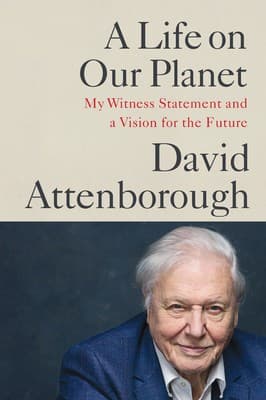
A Life on Our Planet: My Witness Statement and a Vision for the Future
David Attenborough
Read November 28, 2025
View on Goodreads →This fine book by British national treasure Sir David Attenborough is part memoir, part witness statement, and part call to action. He uses the story of his own long and fascinating life as a frame for the immense changes in the natural world over the last century, switching between personal anecdotes, global data, and a clear-eyed view of what we have done to the planet.
Attenborough threads both pessimism and optimism through the book, and backs both with science. We have undoubtedly wrought huge damage, ecosystems degraded, species lost, and atmospheric carbon rising relentlessly. In 1937, when he was eleven, the world population was about 2.3 billion, atmospheric carbon 280 ppm, and remaining wilderness roughly 66 %. By 2020, at ninety-three, those numbers had shifted to 7.8 billion people, 415 ppm, and only 35 % wilderness. The contrast is stark and he does not sugar-coat it.
To its credit, this is not a book of leftist doom or vague moralising. I was a bit worried by the opening framing around Chernobyl, which can feel like a heavy-handed metaphor at first, but the way he returns to it at the end works well. The exclusion zone in Ukraine has effectively become an outstanding natural reserve simply because people left. Wildlife has thrived. Attenborough uses this to underline a simple point our presence is powerful, but it is also ephemeral, and nature is surprisingly quick to reclaim space when given the chance.
Stylistically, it is very much Attenborough, clear, calm, and quietly urgent rather than shouty. He repeats a few key ideas, like the need for “wisdom” rather than just intelligence, and the reminder that our planet is “small, isolated and vulnerable”. These are not new concepts if you have read much climate or environmental writing, but hearing them distilled in his voice, anchored in a lifetime of direct observation, gives them extra weight.
At the same time some genuine improvements are a little ignored. Forested area has been expanding in many parts of the world for decades, some species have been brought back from the brink, and there are examples of successful conservation and smarter land use. It is not a wall of despair, which makes the warning land more strongly.
Why four stars and not five? Mainly because, for me, it sits slightly awkwardly between genres. It is not quite a full autobiography, and not quite a deep technical book on climate science or ecology, so readers who want one or the other in depth might feel a little under-served. The solutions section is OK but high level, and if you already follow these topics closely, much of it will feel familiar. And I disagree that say there are too many people or that we need to reduce consumption - we just need to do it in a green way. I am sure it is possible. Not sure it is probable.
That said, it is a thoughtful, humane, and often moving summary of where we are and how we got here, written by someone uniquely placed to tell that story. As an accessible overview of the planetary crisis from a voice almost everyone trusts, it is hard to beat.